
Perhaps the oldest type of domesticated rabbit, originally bred in Ankara, Turkey. They are known mainly for their wool, which is very long and can be removed by plucking or shearing (pulling loose wool gently out).
There are many various breeds of those rabbits. Four of them are ARBA (American Rabbits' Breeders Association) recognized. Among those breeds are German, French, English, Satin, Giant, Chinese, Finnish, Swiss, etc.
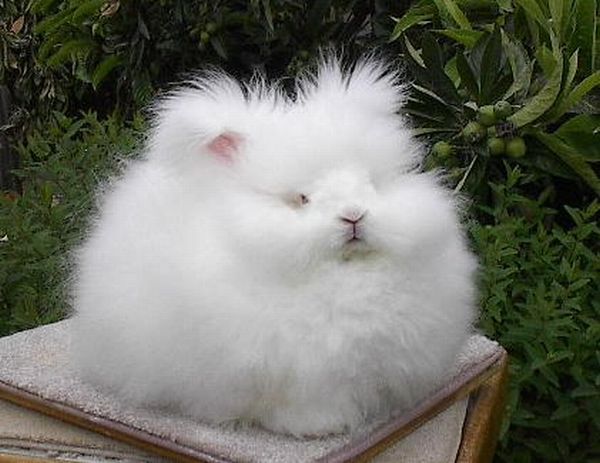
English Angora
English Angoras is a show breed derived French Angoras, who were used for commercial purposes. English Angora rabbits are adorned with so-called "furnishings," - i.e. they have wool growths on the front feet and tips of the ears, and their body wool is very thick. Those rabbits are considered gentle in nature, but for those who don't enjoy animal grooming owning one of those is not recommended .
French Angora
The main characterictics of French Angora is that the guard hairs are on the surface, with wool serving as an undercoat. Ear tufts are allowed but generally not preferred by breeders.
Giant Angora
The Giant Angora is the largest type of Angora rabbit. Besides the guard hairs and underwool, it also has an "Awn Fluff" that doesn't exist in the other three Angora types of rabbits.
Satin Angora
The breed comes from a cross between a French and a Satin Angora. The breed is named so for it's very delicate wool texture. The rabbits of this breed have no furnishings on it's face, ears, or feet, and it is also groomed very easily compared to the English Angora. Satin's wool is said to be strongest for spinning.


Posted in
Rabbits


There are many types of Chinchilla rabbits, but only three of them are recognized by the ARBA.
American Chinchilla
This breed, originally "Heavyweight Chinchilla Rabbit", is basicslly the same Standard Chinchilla, except for it's size. This breed was produced by breeding Standard Chinchillas for large size. This breed came from France and was bred to current standard by M. J. Dybowski. Those rabbits were first introduced to the US for the first time in 1919.
The rabbits are stocky and have a light curve to their bodies, starting at the nape of their necks and all the way through to the rump. Their ears are nearly always straight erect. In show, body type of rabbit is considered to be more important than it's color. American Chinchillas will be disqualified if their body type resembles a Flemish Giant Rabbit. If they are overweight, junior and intermediate American Chinchilla Rabbits can be shown higher than their actual age. Those bucks and does who are under 6 months old and weight less than 9 pounds are considered juniors. Intermediate rabbits are 6 to 8 months. Intermediate bucks weigh less than 11 pounds and does weight less than 12. Seniors are over eight months of age. Senior bucks weigh between 9 and 11 pounds. Doe rabbits weigh between 10 and twelve pounds.
Those rabbits breed very good, with an average litter of seven to ten babies.
Standard Chinchilla
This breed is originally from France. It was first introduced to the US after the World War I. The color of the coat is very distinctive: the fur undercolour is slate blue at the base, the middle is grey, slowly merging into white and black at the tips - very much like the chinchilla, the rodent after which this rabbit breed is named.
Giant Chinchilla
This breed was produced by crossing the Chinchilla rabbits and Flemish Giants; it is originally from the US. The breed is used mainly as a commercial meat rabbit.


Posted in
Rabbits
This breed is perhaps one of the largest and oldest of the fur rabbits. Those rabbits were first bred in a small town called Beveren, in Belgium. The coat can be almost any color - black, white, brown, blue, lilac, but only the white, black, blue, and variations are accepted by the ARBA. Also, there is a very rare breed variety, which is called the "Pointed Beveren". It comes in the same five basic colors, but its hairs are white-tipped. The original variety is blue.
The average length of fur is rather long - spanning from one and a quarter to one and a half inches. This breed has a mandolin-shaped body. Those rabbits are usually bred for meat and fur. Their young are large, the litters grow fast, and the does are usually docile and make good mothers. This breed is also easily raised in all wire hutches.
Posted in
Rabbits
This breed was first discovered in the Netherlands and was brought to England around 1860. It remains popular to this day. Dutch rabbits have color markings: white wedge down the face, circles around the eyes, which extends to the whiskers, white on the the hind feet, a line between the ears, a wedge-shaped mark on the neck, the line dividing the colored part of the body from the white part (the top portion is called "the saddle", and the one under the belly - "the undercut".) When rabbits are judged, the markings account for half of the total score. The type of the body, fur, condition and color make up the other 50%. Because the markings are a genetic trait, those patterns can also be seen on other breeds. Dutch rabbits do well in the sport of hopping. Also, they make excellent show and pet rabbits.
Posted in
Rabbits
Standard Rex
This breedbreed is known for its specific fur, which feels like a velvet. It is often used as a substitute for other animals' fur. Standard Rex fur has shortened so-called "guard" hairs. This makes the coat very dense and short. This kind of coat would be mistaken for an undercoat on a normal rabbit.
This breed has been used for meat and fur production. Since '85, the Rex breeding for fur almost stopped, when breeders realized that there are animals much larger that are just as soft. Those prolific rabbits have large litters with large numbers of kits, often 9 or more. Females are known as good mothers and make good foster mothers for other rabbits.
Mini Rex
This breed, also called the "Velveteen rabbit", was produced from the Standard Rex rabbit. Mini Rex's fur has a plush feel to it, like velvet, which offers a distinct feel to the touch, like the standard Rex breed. For rabbit shows, the Mini Rex's fur is worth about 35 percent of the total score. Those rabbits are popular with exhibitors. Of the compact type rabbits, they are also easiest to breed, and females are very good mothers. Mini Rex perform excellent in the Rabbit Hopping.
Posted in
Rabbits




.jpg)


