The Tank Bred Kuda Seahorse is a moderately sized seahorse and is also known as the Estuary Seahorse. This species is colored a cream, yellow or gold and often with a darker band running down the back. Hippocampus kudaactually comes in many color forms including yellow, orange, brown, and even black. Some individuals may have spots. These captive bred seahorses are a great addition to a seahorse specific aquarium and are adjusted to accepting frozen Mysid shrimp as well as other vitamin enriched meaty foods.
For the best results, seahorses should be kept in a separate, species-only tank that is 30 gallons or larger with multiple branching decorations which they can grab with their prehensile tails. The reason for this is that seahorses are very slow methodical eaters and when maintained with other fish, they will never receive the proper amount of food to thrive in the aquarium. Seahorses tend to get along with pipefish, but they are a slightly faster feeder than the seahorse so it is imperative that the aquarist offers the proper amount of food for the seahorse. In order to maintain the coloration of these wonderful animals it is ideal to keep décor of a similar coloration in the aquarium.
These Tank Bred seahorses are very hardy, and make a smart alternative to wild caught species. It is recommended not to combine Tank Bred seahorses with those that have been harvested from the wild, due to the possibility of spreading disease.
Approximate purchase size: Small: 2" to 2-1/2", Medium: 2-1/2 to 3", Large: 3" to 4"
Posted in
SaltWater Fish

The Banded Pipefish is a type of reef pipefish or flagtail pipefish. This fish is a stronger swimmer than its seahorse cousins and rarely comes into direct contact with the substrate. In the wild, the Banded Pipefish can be found swimming under rocky overhangs, corals, or close to the floor of its reef habitat.
The Banded Pipefish has a long, slender body with a tiny, tubular mouth and an oval, flag-like tail. The body is creamy white with dark red to black vertical rings from the snout to the tail. The tail is bright red with a white margin and dot in the center.
The Banded Pipefish is difficult to keep due to its unusual feeding requirements. It normally prefers to eat only live copepods in a mature reef aquarium with plenty of live rock or macroalgae. An ideal diet to start this fish on is
Nutramar Tigrio Bottled Live Copepods, and vitamin-enriched live baby brine shrimp. However, live baby brine should not make up the majority of its diet. Over time, the Banded Pipefish may become accustomed to eating
frozen CYCLOP-EEZE®, small
Mysis, and
Nutramar Ova.
After an elaborate courtship dance, the female will attach her adhesive eggs to the flat area on the underside of the male's trunk. A pair will regularly mate in an aquarium if well-fed. It is not easy to determine gender, but mature males typically have a flattened appearance due to the brood patch, while females are more round.
This social species is best kept in mated pairs or groups of its own kind in an aquarium that is 50 gallons or larger. It may be kept with small, shy fish such as small gobies, seahorses, dragonets, and firefish. Aggressive, territorial, or fast-moving fish do not make good companions. Pipefish will be harmed by anemones and corals with stinging tentacles or corals that are large enough to consume them, such as brain corals. Pipefish can also be harmed by invertebrates such as crabs and large shrimp.
Approximate Purchase Size: Small 3" - 4 1/2" Medium 4 1/2" to 6"
Posted in
SaltWater Fish
It is easy to see why the Scarlet Reef Hermit Crab is one of the most popular reef maintenance animals. Paguristes cadenati is very hardy and requires minimal care in a well-established system. More importantly, however, these small hermit crabs have a voracious appetite for detritus and algae. In fact, they are particularly fond of nuisance algae of the filamentous, hair, and slime varieties, as well as cyanobacteria. Finally, unlike some hermit crabs, most Scarlet Reef Hermit Crabs are very peaceful towards their tankmates.
Also known as the Red Reef or Red Legged Hermit Crab, the Scarlet Reef Hermit Crab is named for its bright red legs, which are contrasted by their yellow face. Native to the reef faces and coral rubble of the Caribbean and Western Atlantic, these active scavengers can consume large amounts of animal matter and algae. Despite their large appetites and constant feeding habits, the Scarlet Reef only grows to an adult size of 1-1/2" in length.
In the home aquarium, Paguristes cadenati is best kept in an established reef system with ample algae supplies. However, they will eat almost anything, including fish food and invertebrate diets. If algae levels are insufficient, supplement their diet with dried seaweed and other marine foods.
Like other hermit crabs, an ample supply of empty shells should be available for the Scarlet Reef Hermit Crab to move into as they molt and grow. As with all invertebrates, they do not tolerate copper-based medications and extreme fluctuations in water parameters. Also, take special care to ensure an invertebrate-friendly environment free of predators.
Approximate Purchase Size: 1/2" to 1"
Posted in
SaltWater Fish
The Ocellaris Clownfish may be one of the aquarium industry's most popular marine fish. Its beautiful orange body dressed with white bands outlined in black instantly distinguishes the Ocellaris Clownfish. This member of the Pomacentridae family is an excellent addition to almost any saltwater aquarium system. What makes this specific variety even more appealing to aquarists is the fact that each Ocellaris Clownfish is tank-bred to help protect the fragile reef environments of the world.
The Tank-Bred Ocellaris Clownfish has other unique advantages over wild-caught species. For one, the Tank-Bred Ocellaris Clownfish is very hardy and more accustomed to conditions found in home aquariums. Therefore, it makes a great choice for novices and seasoned aquarists alike. The Tank-Bred Ocellaris Clownfish can also be kept with a variety of other tank-bred clownfish, if introduced into the aquarium at the same time.
The Tank-Bred Ocellaris Clownfish is also easy to breed in the home aquarium. The females will be the largest of the pair and the two fish will usually stay close to each other in the aquarium. The Tank-Bred Ocellaris Clownfish is an egg layer and will deposit the eggs on a flat surface and defend the eggs from other tankmates. The eggs will normally hatch in 6-11 days depending on the water temperature. The fry must be reared in a separate aquarium on a diet of rotifers followed by baby brine shrimp.
The Tank-Bred Ocellaris Clownfish is also known as the False Percula Clownfish, False Clown Anemonefish, and Anemone Demoiselle. This fish is sometimes sold as the Percula Clown, even though it is not. The color pattern is very similar, but it is not as bright orange. The Tank-Bred Ocellaris is usually significantly lighter in coloration and is often missing one or more stripes. It may also have non-symmetrical stripes on the sides of its body, making the Tank-Bred Ocellaris Clownfish unusual and appealing to most hobbyists. The coloration of these fish will darken to a nice solid orange with age.
This Clownfish is an aggressive eater. It will accept most meaty foods and frozen herbivore preparations.
Approximate Purchase Size: Small: 3/4" to 1-1/4" Medium: 1-1/4" to 1-3/4"
Posted in
SaltWater Fish
The Yellow Hawaiian Tang is for many aquarists, the definitive fish of home saltwater aquariums. With its oval-shaped, vibrant yellow body, Zebrasoma flavescensbrightens any marine system. The Yellow Hawaiian Tang is an active swimmer that will glide throughout your aquarium in near constant motion, acting as an aquarium tour guide of sorts to any onlooker who follows its meandering swim path.
Though most common to the reefs of Hawaii, the Yellow Hawaiian Tang's natural habitat is actually widespread throughout Indonesia and the Great Barrier Reef. The Yellow Hawaiian Tang is also known as the Yellow Sailfin Tang or Yellow Surgeonfish. For best care, it should be housed in an aquarium of at least 100 gallons with ample room to swim. Like other Tangs, this member of the Acanthuridae family demonstrates territorial aggression towards its own species, or Tangs in general. Therefore, it is best to keep just one Yellow Hawaiian Tang per aquarium, unless multiple Yellow Hawaiian Tangs are introduced into the system simultaneously.
Although the Yellow Hawaiian Tang will eat meaty foods along with the other fish in the aquarium, it is important the Yellow Hawaiian Tang is offered plenty of marine based seaweed and algae. This will strengthen its immune system, reduce aggression and improve overall health. Offer dried seaweed tied to a rock or use a
veggie clip, and feed at least three times per week.
Sea Veggies,
Seaweed Salad and
Ocean Nutrition are all ideal products and are very easy to use.
The Yellow Hawaiian Tang is a very common, extremely popular, and hardy addition to any fish-only or reef aquarium system.
Approximate Purchase Size: Small: 1-1/2" to 2-1/2"; Medium: 2-1/2" to 3-1/4"; Medium/Large 3-1/4" - 4-1/2" Large: 4-1/2" to 6"
Posted in
SaltWater Fish
The Zebra Barred Dartfish is also referred to as the Zebra Dart Goby, Bar Goby, Barred Dartfish, Zebra Goby, or Chinese Zebra Goby. Both the head and body of the Zebra Dart Goby are light green. Its attractive slender body has numerous vertical, evenly-spaced thin orange stripes displaying an intricate pattern.
A tank of at least 30 gallons or larger with a sandy bottom, plants, and coral will provide a healthy environment. Small groups or pairs tend to do better in an aquarium than a single individual, but all need to be introduced to the tank simultaneously and have plenty of swimming room.
The meaty diet of the Bar Goby should include fresh or frozen seafood and brine and mysis shrimp.
Approximate Purchase Size: Indo-Pacific: Small 1-1/2 to 2", Medium 2" to 2-1/2", Large 2-1/2" to 3", Xlrg 3" to 4"
Posted in
SaltWater Fish
The Niger Trigger or Redtooth Trigger is a striking fish for the home aquarium. The exact color of the Niger Triggerfish varies in this species of fish, and can also change from day to day between purple, blue and blue/green with a striking, lighter blue highlight on the fins and long tail lobes. The color temperature of the lighting also plays a role in the coloration of any fish in the home aquarium. As an adult, they acquire bright red teeth, and are normally dark purple in color with a blue/green highlight around their face making them quite interesting to watch when they eat.
The Niger Triggerfish requires a 180 gallon or larger aquarium with rocks and caves for hiding, and may rearrange the landscaping and rocks. It vocalizes using a "grunting" sound. They are a great active fish for the more aggressive, fish-only display.
The Niger Triggerfish needs a varied diet of meaty foods including; squid, krill, clams, small fish and hard shelled shrimp to help wear down their ever growing teeth.
Approximate Purchase Size: Small: 1" to 2"; Medium: 2" to 3"; Medium/Large: 3" to 4"; Large: 4" to 5"; X Large: 5" to 7"
Posted in
SaltWater Fish
The Midas Blenny is an excellent candidate for a reef tank. It is a beautiful, deep golden-yellow with a shadow of blue under the chin and bright, blue-rimmed eyes. When swimming, the motion they use is very eel-like.
This blenny will appreciate a minimum tank of 30 gallons or larger with numerous rocks on which to perch. Sometimes, the Midas Blenny will vex small planktivores and has been known to nip at firefish and gobies. Larger tanks are advantageous as many of the Midas Blenny's aggressive behavior traits seem to relate to a confining tank situation.
Unlike most blennies, the Midas Blenny requires a meaty diet including finely chopped crustacean flesh, mysis and vitamin-enriched brine shrimp, along with frozen herbivorous preparations, micro and blue-green algae.
Approximate Purchase Size: Small: 1" to 2"; Medium: 2" to 3"; Large: 3" to 4"; X Large 4" to 6"
Posted in
SaltWater Fish
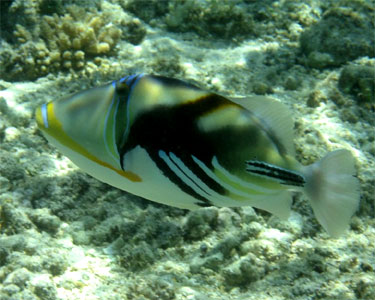
The Humu Picasso Triggerfish, also known as the Humuhumu Triggerfish or Picasso Triggerfish, has a wacky, painted appearance. It has a tan body with gradient dark bands, and vibrant blue and black stripes on the top of the head, with a yellow stripe from cheek to cheek and deeply set-back eyes.
A 70 gallon or larger aquarium with rocks and caves provides a good habitat. It will rearrange the landscaping and rocks as it wanders in and out of the caves. It vocalizes using a "grunting" sound. The Humu Picasso Triggerfish makes a great conversation piece.
The Humu Picasso Triggerfish needs a varied diet of meaty foods including; squid, krill, clams, small fish and hard shelled shrimp to help wear down their ever growing teeth.
Approximate Purchase Size: Small: 1" to 2"; Medium: 2" to 3"; Medium/Large 3" to 3 3/4"; Large: 3 3/4" to 4 1/2"; X Large 4 1/2" to 5 1/2"
Posted in
SaltWater Fish
The Flame Hawkfish, also known as the Brilliant Hawkfish, has a bright red body with dark markings along the dorsal fin and around the eyes. They are a very personable fish, and are great for reef aquariums as long as there are no small shrimp maintained in the aquarium.
It requires a 30 gallon or larger aquarium with plenty of live rock for structure and hiding. They are mostly a peaceful fish that spends most of its time perching and swimming within the branches of hard corals. Use caution when adding to an aquarium with small species of bottom dwelling gobies and blennies. They are bottom dwellers and tend to "hang out" on rock perches, waiting and readying themselves for food to come by.
The Flame Hawkfish diet should include a variety of marine meats, frozen preparations, and live feeder shrimp.
Approximate Purchase Size: 1" to 2-1/2"
Posted in
SaltWater Fish
The Firefish is one of the more popular fish in the marine hobby. It is a magnificent fish with brilliant coloration, a unique body shape, and unparalleled personality. Also known as the Firefish Goby, Fire Goby, and Magnificent or Fire Dartfish, Nemateleotris magnifica has a yellow head, white anterior, and pinkish to orange-red posterior. The dorsal, anal, and caudal fins are highlighted in black. In addition to its striking coloration, the Firefish Goby is also heralded as a sweet-tempered fish with lots of personality. And, because of its small size, the Firefish Goby makes a great addition to the smaller reef system.
In the wild, the Firefish Goby is usually found in groups hovering over the reef, harvesting planktonic food that drifts by in the current. The docile, Firefish Goby is timid and in the wild, each will have a "bolt-hole" into which it quickly ducks when threatened. In the home aquarium, the Firefish Goby needs multiple safety zones amongst rocky crags or outcroppings into which it can dart if stressed. This member of the Gobiidae family is generally not aggressive towards other fish except those of its own species. However, a mated pair can live peacefully together.
To best recreate their wild habitat, the Firefish Goby requires a 10-gallon or larger system with moderate lighting conditions and a moderate current passing over the live rock "reef." Keep in mind that a stressed Firefish Goby will try to jump out of your aquarium. As such, house the Firefish Goby in aquarium systems with a lid. Hobbyists who use a halide system with an open top should construct a Plexiglas "edge" around the trim, at least 10" tall.
Along with algae and zooplankton growing in the aquarium, the diet of the Firefish Goby should consist of finely chopped small crustaceans, vitamin-enriched brine fish (live or frozen), mysis shrimp, and prepared foods.
Approximate Purchase Size: 1-1/2" to 2-1/2"
Posted in
SaltWater Fish
The Wheeler's Watchman Goby is also commonly referred to as the Pretty Prawn, Maiden, Orange Spotted Diamond, Orange-dashed, or Orangespotted Sleeper Goby. It was first discovered in the Indo-Pacific Ocean in 1956 by Tomiyama. The head and body are white with orange spots. It is a very timid fish that makes a great addition to the reef tank because of its longevity.
It should be housed in a 50 gallon or larger aquarium with live sand as the substrate, and an attached populated refugium. The Wheeler's Watchman Goby uses shallow burrows in the substrate as refuge, keeping the substrate well oxygenated. It rarely becomes aggressive towards other fish, but is territorial, and will fight with its own kind unless they are a mated pair.
The Wheeler's Watchman Goby feeds off the bottom as it sifts through the sand. Its diet should include a variety of live and frozen brine shrimp, mysis shrimp, live black worms, and prepared foods for carnivores. It should be fed frequently.
Approximate Purchase Size: Small 1 1/2" to 2"; Medium 2" to 3"; Large 3" to 4"; X Large 4" - 5"
Posted in
SaltWater Fish
The Citrinis Clown Goby, also known as the Citron or Citrin Goby, is common within the reefs of Sri Lanka and the Coral Sea. They are usually found among soft and hard coral colonies. They are a small yellow fish with blue vertical lines around the eyes and gills, and a blue horizontal line along the dorsal fin. Their body color can vary between dark brown and pale yellow. They are a peaceful fish that makes a wonderful addition to a reef aquarium containing colonies of polyp coral and other soft corals, as they enjoy swimming and hiding amongst the polyps.
The Citrinis Clown Goby feeds on the mucous polyps of Acropora sp. in the wild and is considered reef safe but will nip at the polyps or bases of Acropora sp. and possibly other SPS corals. If the SPS dominated aquarium is not heavily stocked with very mature colonies these fish may severely damage Acropora sp. in these displays.
It requires a 10 gallon or larger aquarium and prefers branched corals, often resting on them for hours at a time. It will rarely become aggressive towards other fish, but will fight with its own kind in smaller tanks. It is best if it is kept with other docile species.
It is common for clown gobies to spawn in an aquarium. Caution should be exercised if the aquarium contains Acropora sp. or similar SPS corals. They will lay their eggs on the underside of the coral's branch, which will cause tissue recession in that area of the coral.
The Citrinis Clown Goby's diet should consist of a variety of brine shrimp, frozen mysis shrimp, table shrimp, and frozen food preparations for carnivores.
Approximate Purchase Size: 1-1/2" to 2"
Posted in
SaltWater Fish