house rabbit may seem like the perfect companion for your child, but this is not always the case. Many children are too young to handle a rabbit appropriately. Bunnies may look cute and cuddly, but they do not behave in ways typified in children's stories or cartoons.
Many rabbits do not enjoy being held and will kick and claw when picked up. Your child may end up with some painful scratches. Your rabbit may end up far worse. Rabbits are delicate creatures and struggling to get out of the grasp of a child (or adult) can leave them with broken bones or other injuries.
Rabbits are timid creatures. Loud noises or children running around can scare them. Your child may be disappointed that Bunny does not want to come and play when called. Bunny will be more inclined to come play with your child if he/she is sitting quietly on the floor. Rabbits sometimes want to be left alone to eat or nap, and children need to be reminded of that.
Adopting a rabbit is a very big commitment. Rabbits have a life span of over ten years. If you adopt a baby bunny for your ten year old, be prepared to care for the rabbit when your child has gone off to college. Many shelters have older rabbits that would love a caring forever home.
Children may lose interest in a rabbit when the novelty has worn off or find it burdensome to care for a rabbit. Rabbits are easily litter box trained, but their litter needs to be changed regularly. They require fresh food and water daily. They also require regular grooming and nail clipping. Rabbits are social animals that require a lot of individual attention. They need daily exercise and playtime, and when they are not in a pen or cage, you will have to ensure that your home is bunny proofed. All of these factors need to be taken into consideration when determining if a rabbit is right for your family.
So while children and rabbits can certainly interact well together, a rabbit's primary caregiver should always be an adult.
Bunny Rabbit Food
22:12
Posted by
Naughty Boy
0
comments
But the base of a bunny food pyramid actually isn't filled by pellets. The most important ingredient to a healthy bunny's diet is hay. Fresh hay should be provided to rabbits at all times so they can graze when they please. (See the real rabbit food pyramid in a PDFcreated by the San Diego House Rabbit Society.)
Fiber for Digestion
Rabbits have digestive tracts that are specially adapted to break down fibrous vegetation. Hay provides the fiber necessary to keep their digestive systems healthy and motile. A disruption to a rabbit's digestive cycle can cause gastrointestinal (GI) stasis, a condition in which the contents of the digestive tract become compact, and the rabbit has difficulty passing the mass through. Providing unlimited, fresh hay helps deter this serious, potentially deadly condition.
Roughage for Dental Health
Not only is hay necessary for good digestive health, it also wears down rabbits' teeth, which continuously grow. Regular hay consumption helps prevent rabbits from developing sharp hooks on their teeth known as molar spurs. Molar spurs can be very painful, causing rabbits to stop eating. Once this happens, GI stasis can occur.
What Kind of Hay
For baby bunnies, alfalfa provides the high caloric content necessary for their development. Once rabbits reach seven months of age, gradually switch them over to timothy, orchard grass, and/or oat hay. For people with allergies, look for the second cutting of hay. When harvesting hay, the first cutting is a coarser hay that includes a lot of stems and seed heads (and inevitably, a lot of pollen). The second cutting consists of a softer hay that includes more leaves and fewer stems and seed heads, thereby reducing people's allergic reactions significantly.
Where to Buy
You can usually find bags of hay at most pet stores. However, the absolute most economical place to purchase hay is direct from a local farm. Check Craigslist's farm/garden section or your local classifieds to find a hay farmer. You can purchase hay in bulk (by the bale) for a fraction of the cost of a pet store bag of hay. In fact, one bale (stored in a cool, dry location) can feed a single rabbit for months and usually costs well under 10 dollars if bought directly from the farm.
If there are no farms in your area, don't despair. Feed stores are also a good source for less expensive bulk purchases. In the absence of those, go online. Nowadays, there are many reputable online retailers of hay (and a few of which provide the option of the second cutting, such as American Pet Diner and Sierra Valley Pet Hay). For a full list of online bunny supply stores, see our Resources page.
Posted in
Bunny Rabbit Food
Bunngy Rabbit Behavior
22:07
Posted by
Naughty Boy
0
comments
1) Chewing and Digging
Disciplining Your Rabbit
My first reaction when my rabbit would start chewing the furniture, rug, or molding was to firmly say, "No!" and clap my hands. While I thought this would help her understand that her behavior was undesirable, I quickly realized that it wasn't as effective as I'd hoped. Reprimanding the rabbit would simply distract her momentarily. She would either move on to a new activity only to return later, or she would resume the same naughty behavior once she'd decided the noise was gone and all was well again. There did not appear to be an understanding that her behavior caused the clapping and saying "No!", and that she should discontinue that activity completely.
It is not effective to discipline your rabbit after the fact. If you come home to find your bunny resting comfortably and the molding is chewed up, it is not the time to reprimand. She will not understand why you are angry, and it will just stress her out. So while reprimanding your rabbit at the time of the naughty behavior may be slightly effective, it is best to also use the techniques below.
Rewarding Your Rabbit For Good Behavior
Rabbits tend to learn better when they are rewarded for good behavior, rather than when they are disciplined for bad behavior. Determine what your rabbit enjoys most, such as praising, petting, grooming, or small healthy treats. When she chews and digs acceptable items like chew toys, old phonebooks, or her cardboard castle, let her know this is good behavior! This brings us to the next tactic.
Providing Acceptable Items to Chew and Dig
If your rabbit has a continuous supply of timothy hay to eat, some toys to play with, a grass mat to dig on and a cardboard castle to renovate, she will have less of an inclination to chew your furniture and dig up your carpet. Your rabbit needs to chew and dig on a continual basis. This wears down her teeth and claws, which are always growing. Providing safe items to chew will ensure good dental health for your rabbit.
Except in rare cases, you will still need to trim her nails. You cannot declaw a rabbit. Not only is it extremely painful, but rabbits have no pads on their feet and need claws for grip.
Protecting Your Belongings
Even if your bunny is well-behaved, it is best not to tempt her. Keep all wires, important documents, and other cherished belongings out of reach or protected. In terms of protecting your furniture, I've read a few articles that suggest applying Tabasco sauce or Ivory soap (specifically the Ivory brand because others may have harmful chemicals). I did not particularly want my furniture covered in soap or Tabasco sauce, so I have not tried this. However, I have tried putting on a special bitter lime spray that was supposed to keep rabbits away from furniture. This was not effective on my rabbit. In fact, she even licked the spray off.
So, I use a puppy-pen to block off the part of the room that has nice furniture she likes chewing. I keep the rest of my nice furniture in other rooms that she can't access. For more information, see the Bunny Proofing Your Home article.
So with a little patience and supervision, some rabbit toys, and a bit of bunny proofing, you are well on your way to creating a harmonious life with your pet rabbit.
2) Rabbit Noises
Growling
If your rabbit growls or grunts at you, she's not happy about something. Maybe she's angry that you're poking your hand into her cage, and she doesn't want you in her territory. Growling can be a sign of anger, fear, uncertainty and stress. The better you get to know your bunny, the more you'll discover what her different growls mean.
Crying
Your bunny may cry. Sometimes a bunny will let out a little cry or whimper and thump their back feet. This is interpreted much as you would understand the same noise in puppies or people.
Licking
If your bunny licks your face or your hands, be happy. She's telling you I love you!
Screaming
You never want to hear your bunny scream. A bunny scream is usually shrill. It's a heart-breaking sound, and it generally signifies your bunny is either hurt or dying. You'll want to get her help immediately.
Flopping
Your bunny is on top of the world. She is so happy, she can think of no better way to show her happiness than flopping over, eyes closed, taking some time to relax.
Binkying
You've got one happy bunny on your hands. She's gyrating, dancing, hopping high in the air and shooting across the room at lightening speed. She's so happy she's a bunny and living with you.
Thumping
Your bunny will thump her back legs for a number of reasons including fear, anger and warning you to danger lurking.
The Bunny 500
It's 6 a.m., and the Bunny 500 has taken off again. Your bunny or bunnies are in their room, when all of a sudden, zoom! They race around the room over and over again at top bunny speed, until they're ready to just chill out, munch on some hay, chew the phone book or flop down for a much-needed nap.
Chinning
Your bunny is rubbing her chin all over the furniture, the book you're reading and you. This is just her way of marking her territory. She's saying, hey, this is mine.
Advice: You may search Google for "rabbit noises". This will give you many links to related articles.
3) Playing with your rabbit
Some bunnies will play fetch just like a dog. It is best to have toys that they can grip with their teeth for this. Toys for birds are good for this, as are paper towel rolls cut into smaller rings. They will pick up their toys in their mouths and throw them with a flick of the head, or carry it back to you. Some bunnies enjoy playing a nice game of chase. Your bunny may prod you with his/her nose until you chase them around the room only to turn around and chase you.
My bunny, Buka, loves to start on one side of the room and try to run to the other side while I stand in the middle and try to catch him. (I always let him win.)
Bunnies especially like being mischievous. They will sometimes steal something you are holding and running away with it hoping you will chase them. While you may find it slightly irksome that your important papers are now clenched in the teeth of your bunny he/she will find your vexation amusing.
There are many benefits to playing with your rabbit. For you it may offer relaxation or amusement. For your rabbit it offers a chance to bond with you and foster a relationship. Playing provides your bunny with mental stimulation and physical exercise, both of with are essential to bunny health.
When you are away from home your bunny still needs to play, so it is a good idea to have a selection of toys for him/her. One of our bunnies favorites is their cardboard castle. (See our article on Building a Cardboard Castle for your Bunny.) They love to dash in and out or laze about away from the bustle of the household in their castle. They also love to chew on the walls and scratch at the floors.
Toys are best when they address a bunny behavior, like the cardboard castles. Straw mats and boxes full of paper shreds are good for digging. Cardboard tunnels address their burrowing instincts. Cardboard boxes or cat boxes make great toys to climb or jump onto. Wicker baskets are great for chewing and climbing on. For more information about chewing and digging behavior, see How to Deal with Chewing & Digging.
Other toys can include untreated wood products, hard plastic baby toys, plastic balls with bells inside, pine cones, oatmeal boxes and paper towel rolls, and hand towels. There are toys made specifically for bunnies and most of these are good too. A note of caution: some types of wood can be poisonous for rabbits. These include cherry, redwood and peach.
4) Build a relationship
Her remarks made me realize that a lot of people are unaware that bunnies can have quite affectionate personalities – and that a strong bond between rabbit and owner can be established.
In truth, rabbits are very expressive. When they're happy and full of energy, they'll zip around the room in little bunny blurs, every so often interjecting a few binkies into the circuit. When they're hungry, they'll beg for food or get cranky and start chewing the molding and furniture. When they want attention, they'll dig on your back or your leg until you stop what you're doing and pet them. And if they think you're in the way, they'll let you know by nudging you forcefully with their nose (and they'll follow up with a little nip if you ignore them).
Understanding rabbits' unique language is helpful when bonding with your pet bunny for the long term, but if you recently adopted your bunny, you may not even know how to start the bonding process.
Rabbits are most comfortable on the ground. So your rabbit may not appreciate being picked up and held. If you insist on scooping up little Bunnikins all the time, you may find she starts running away from you and hiding every time you come near. If this is the case, try simply sitting quietly on the floor. Let her approach you on her own terms. When she does, you can gently pet her.
My rabbits like being stroked on their forehead and cheeks. They put their head on the ground and close their eyes in contentment. They also love getting a good back scratch around the shoulders. That said, they tend not to like being touched on the ears, neck, feet, stomach or tail.
Usually, my bunnies are most receptive to petting when they're relaxing after a meal. So if your rabbit doesn't appear interested in affection, wait until just after feeding time. Rabbits are very curious animals, so your bun may just be distracted by all the potential mischief to be had.
Bunnies have very distinct personalities. With time and patience, you will learn what makes your rabbit happy. And in return, your bunny will come to trust and appreciate you.
Posted in
Bunny Rabbit Behavior
Type Of Bunny Rabbit
21:54
Posted by
Naughty Boy
0
comments
Angora Rabbit
21:43
Posted by
Naughty Boy
1 comments
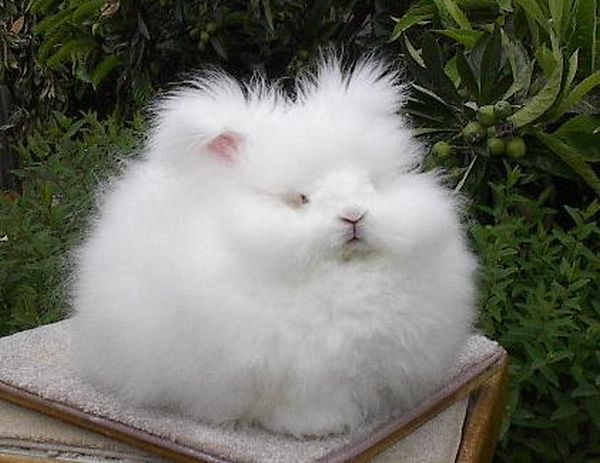
Perhaps the oldest type of domesticated rabbit, originally bred in Ankara, Turkey. They are known mainly for their wool, which is very long and can be removed by plucking or shearing (pulling loose wool gently out).
There are many various breeds of those rabbits. Four of them are ARBA (American Rabbits' Breeders Association) recognized. Among those breeds are German, French, English, Satin, Giant, Chinese, Finnish, Swiss, etc.
English Angora
English Angoras is a show breed derived French Angoras, who were used for commercial purposes. English Angora rabbits are adorned with so-called "furnishings," - i.e. they have wool growths on the front feet and tips of the ears, and their body wool is very thick. Those rabbits are considered gentle in nature, but for those who don't enjoy animal grooming owning one of those is not recommended .
French Angora
The main characterictics of French Angora is that the guard hairs are on the surface, with wool serving as an undercoat. Ear tufts are allowed but generally not preferred by breeders.
Giant Angora
The Giant Angora is the largest type of Angora rabbit. Besides the guard hairs and underwool, it also has an "Awn Fluff" that doesn't exist in the other three Angora types of rabbits.
Satin Angora
The breed comes from a cross between a French and a Satin Angora. The breed is named so for it's very delicate wool texture. The rabbits of this breed have no furnishings on it's face, ears, or feet, and it is also groomed very easily compared to the English Angora. Satin's wool is said to be strongest for spinning.
Posted in
Rabbits
Chinchilla Rabbit
21:41
Posted by
Naughty Boy
0
comments
There are many types of Chinchilla rabbits, but only three of them are recognized by the ARBA.
American Chinchilla
This breed, originally "Heavyweight Chinchilla Rabbit", is basicslly the same Standard Chinchilla, except for it's size. This breed was produced by breeding Standard Chinchillas for large size. This breed came from France and was bred to current standard by M. J. Dybowski. Those rabbits were first introduced to the US for the first time in 1919.
The rabbits are stocky and have a light curve to their bodies, starting at the nape of their necks and all the way through to the rump. Their ears are nearly always straight erect. In show, body type of rabbit is considered to be more important than it's color. American Chinchillas will be disqualified if their body type resembles a Flemish Giant Rabbit. If they are overweight, junior and intermediate American Chinchilla Rabbits can be shown higher than their actual age. Those bucks and does who are under 6 months old and weight less than 9 pounds are considered juniors. Intermediate rabbits are 6 to 8 months. Intermediate bucks weigh less than 11 pounds and does weight less than 12. Seniors are over eight months of age. Senior bucks weigh between 9 and 11 pounds. Doe rabbits weigh between 10 and twelve pounds.
Those rabbits breed very good, with an average litter of seven to ten babies.
Standard Chinchilla
This breed is originally from France. It was first introduced to the US after the World War I. The color of the coat is very distinctive: the fur undercolour is slate blue at the base, the middle is grey, slowly merging into white and black at the tips - very much like the chinchilla, the rodent after which this rabbit breed is named.
Giant Chinchilla
This breed was produced by crossing the Chinchilla rabbits and Flemish Giants; it is originally from the US. The breed is used mainly as a commercial meat rabbit.
Posted in
Rabbits
Beveren Rabbit
21:39
Posted by
Naughty Boy
0
comments
This breed is perhaps one of the largest and oldest of the fur rabbits. Those rabbits were first bred in a small town called Beveren, in Belgium. The coat can be almost any color - black, white, brown, blue, lilac, but only the white, black, blue, and variations are accepted by the ARBA. Also, there is a very rare breed variety, which is called the "Pointed Beveren". It comes in the same five basic colors, but its hairs are white-tipped. The original variety is blue.
The average length of fur is rather long - spanning from one and a quarter to one and a half inches. This breed has a mandolin-shaped body. Those rabbits are usually bred for meat and fur. Their young are large, the litters grow fast, and the does are usually docile and make good mothers. This breed is also easily raised in all wire hutches.
Posted in
Rabbits
Subscribe to:
Posts (Atom)


.jpg)